klow
KLOW Peptide for Sale: Price and Buying Guide for 2026
KLOW peptide sells for $145 per 80 mg vial at HEEZ Research, or $1.81/mg. What the blend contains, what a blend COA has to prove, and how to compare listings.
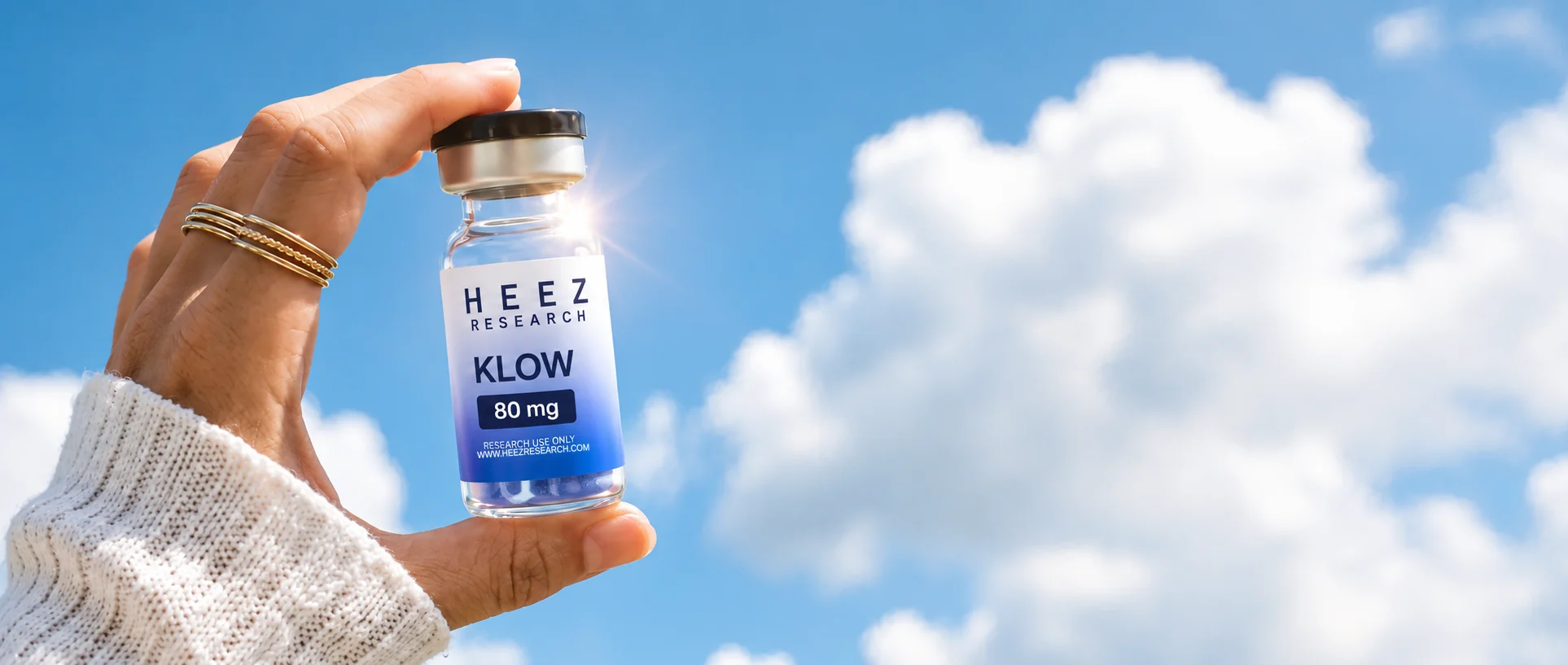
KLOW peptide sells as a single 80 mg vial, $145 at HEEZ Research, which works out to $1.81 per mg of total blend material. That per-mg figure is the one number most KLOW listings have in common, and it is also the one that hides the most. KLOW is not a compound. It is a four-component blend sold under a name that no standards body defines, which means two vials labeled KLOW 80 mg can contain different things in different proportions at the same price. This page covers what to check on a KLOW listing before the price is worth comparing at all.
How much does KLOW peptide cost?
One size is catalogued, so the arithmetic is a single division. The figures below come from Klow price at HEEZ Research, prices as of September 2026 from the HEEZ catalog.
| Size | Price | Price per mg of blend |
|---|---|---|
| 80 mg vial | $145 | $1.81/mg |
Table 1: HEEZ Research KLOW blend size with cost per mg derived from it. Price per mg = price divided by total blend mass, so $145 divided by 80 mg = $1.8125/mg, shown rounded. Prices as of September 2026 from the HEEZ catalog.
Read that column carefully, because it is not comparable to the per-mg figure on a single-peptide listing. On a single-peptide vial, every milligram is the same substance, so $1.81/mg describes one thing. In a blend, the 80 mg is divided between four different components with very different individual values, and the split is not evenly weighted. A KLOW vial is mostly its largest component by mass; the other three are minor fractions of the total. Two blends can therefore both be 80 mg at $145 and still be worth substantially different amounts, purely because the material is distributed differently inside the vial.
That makes total-mass pricing a starting point rather than a comparison. The comparison only becomes real once the listing tells you how the 80 mg is divided, which is the next thing to check.
Buy Klow at HEEZ Research
- Batch-specific third-party COA, HPLC purity and MS identity
- Same-day UPS shipping from Florida on orders before 3 PM ET
- For laboratory research use only
What is actually in a KLOW blend?
Four research peptides, co-lyophilized into one vial: GHK-Cu, BPC-157, TB-500 and KPV. The name is an informal acronym assembled from those four, not a designation with a registered definition behind it, and that distinction has practical consequences.
For an approved drug, the composition is fixed by a registered specification and cannot vary between manufacturers. KLOW has no such document. The four-component recipe is a convention the research-supply market settled on, which means the burden of confirming composition sits entirely with the buyer and entirely on the certificate of analysis for the specific vial being sold. A listing that names the four components without quantifying them has described a category, not a product.
The components are also unequal in what stands behind them. A 2025 systematic review in HSS Journal screened 544 articles on BPC-157 from 1993 to June 2024 and, after duplicates were removed, included 36 studies: 35 preclinical and one clinical (PMID 40756949). The picture is similar across the blend. GHK-Cu has a large literature centred on gene-expression and tissue-repair work (PMID 29986520). The peptide that contributes the smallest components has been studied mainly in intestinal cell models and rodent colitis work (PMID 18061177), and the thymosin fragment is best characterised as an actin-sequestering molecule described in cell biology reviews (PMID 16099219).
One point matters more than any individual component’s record: none of that research studied KLOW. Each body of work examined a single peptide on its own. No published trial has evaluated these four together as the blend sold under this name, so there is no combination data to cite, and any listing implying otherwise is describing the parts while selling the whole. Material sold on these terms is research use only. What the name refers to, where it came from and why the powder is blue are covered in what KLOW peptide is.
What should a KLOW certificate of analysis prove?
More than a single-peptide certificate, because a blend can fail in ways one peptide cannot.
On a single-peptide vial, purity is close to a single question: what fraction of the detected material is the intended compound? A blend has at least three separate questions, and a certificate that answers only the first is incomplete:
- Identity of each component. Mass spectrometry compares observed mass against theoretical mass, and each of the four has a different one. A certificate should show identity confirmed for all four, not for the blend as an undifferentiated whole.
- Ratio. This is the check unique to blends and the one most often missing. A single “99% pure” figure on a four-component vial says the material is 99% peptide rather than contaminant. It says nothing about whether the four are present in the stated proportions. A vial can be 99% pure and still be short on a component.
- Purity by HPLC. Area percent, the share of detected material that is the intended species, reported per component where the method separates them.
Two further details apply specifically to this blend. The largest component is a copper complex, which is why KLOW is a blue-tinted powder rather than the white to off-white of most lyophilized peptides. Colour is therefore a weak positive signal that the copper component is present at all, though it proves nothing about quantity, and the shade varies with fill and lighting. Second, lyophilized material carries counterion, residual solvent and water alongside peptide, so 80 mg is solid mass rather than peptide mass. The figure that distinguishes the two is net peptide content. When it is absent, treat 80 mg as an upper bound and $1.81/mg as a ceiling on value rather than a measurement of it.
Then check what the certificate is keyed to. A certificate naming only the product line tells you something was tested at some point. A certificate carrying the batch number printed on your vial tells you that lot was tested. Per-lot testing costs a seller real money, and on a four-component blend it costs more than on a single peptide, which is part of what separates listings at similar prices. On the HEEZ listing, every lot carries a batch-specific third-party certificate covering HPLC purity and MS identity, with purity stated as 99% or higher as measured.
Why do KLOW listings vary so much in price?
Because the name is doing more work than the specification. Four differences sit behind two prices that look comparable:
The split. How the 80 mg is divided between components is the single largest driver of what a vial is worth, and it is invisible on a listing that does not publish it.
Testing depth. A per-lot certificate covering four components costs more to produce than one certificate covering a product line, and far more than a listing that references testing without publishing anything.
Net peptide content. Whether it is reported, and what it is.
What the price includes. Shipping, handling and whether the material needs cold-chain transport all sit outside the vial price and differ between sellers.
None of those four appear in a per-mg figure. Two listings at $1.81/mg can differ on every one of them.
How does ordering KLOW work?
As a catalog purchase with fixed terms. You can buy KLOW peptide as a single 80 mg vial at $145, prices as of September 2026 from the HEEZ catalog.
HEEZ Research ships same day by UPS from Florida on orders placed before the 3 PM ET cutoff. Lyophilized material ships at ambient temperature, so there is no cold-chain surcharge on top of the vial price. All sales are final. Supply is restricted to qualified organizations, for laboratory research use only.
Common questions about buying KLOW peptide
Is KLOW peptide for sale in the US? As research material, yes. KLOW is not an approved medicine, holds no marketing authorisation, and has no pharmacy channel. It is supplied by the vial to qualified organizations for laboratory research use only, not for human consumption.
What is the KLOW peptide price per vial? $145 for one 80 mg vial, which is $1.81 per mg of total blend material, prices as of September 2026 from the HEEZ catalog.
Is KLOW cheaper than buying the components separately? Not necessarily, and the comparison needs the split to be meaningful. Four single vials give you control over how much of each you hold and four separate certificates; one blend vial gives you a fixed ratio you cannot adjust. Which is better value depends on the proportions you actually need.
Why is KLOW blue? The copper-containing component gives the lyophilized powder a blue tint. It indicates that component is present and says nothing about how much.
Can a KLOW order be returned? No. All sales are final.
Does the price include testing? Yes on the HEEZ listing. Every lot carries a batch-specific third-party certificate of analysis rather than testing being sold as a separate line item.
Buy Klow at HEEZ Research
Shop Klow at HEEZ Research →